
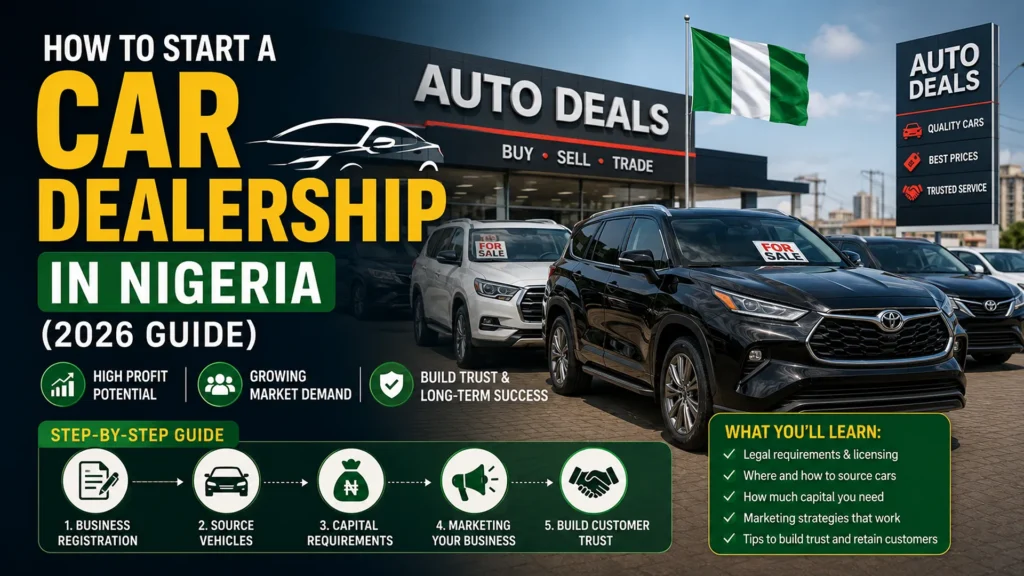
The Nigerian automobile market presents opportunities for entrepreneurs who understand what customers want, where to source vehicles, and how to build trust.
From used cars and fairly used imported vehicles to brand-new automobiles, car dealerships can operate at different levels depending on the entrepreneur’s capital, network, and target market. However, starting a dealership involves much more than buying cars and waiting for buyers.
You need to understand your market, register your business, source vehicles carefully, manage your finances, market your inventory, and establish systems that make customers comfortable doing business with you.
If you’re considering starting a car dealership in Nigeria, here’s a practical guide to the major steps involved.
-
Decide What Type of Car Dealership You Want to Operate
The first step is deciding exactly what kind of dealership you want to build.
You could focus on:
- Used cars
- Foreign-used vehicles
- Brand-new vehicles
- Luxury cars
- Commercial vehicles
- SUVs
- Affordable cars for first-time buyers
- A particular automobile brand
- Fleet vehicles for businesses
- Car sales on consignment
You don’t necessarily need to sell every type of vehicle.
In fact, starting with a clearly defined market can make it easier to understand your customers and manage your inventory.
For example, a dealership specialising in affordable used vehicles for young professionals may have completely different customers, pricing strategies, and inventory requirements from a dealership selling luxury SUVs.
Your choice should therefore be influenced by your available capital, experience, connections, and the demand you can realistically serve.
-
Research the Nigerian Car Market
Before investing money in inventory, research the market.
Find out what vehicles people in your target market are actually buying.
Consider factors such as:
- Purchase price
- Fuel consumption
- Spare-parts availability
- Maintenance costs
- Reliability
- Resale value
- Insurance costs
- Popularity of the model
- Availability of replacement parts
A vehicle that looks profitable on paper may not necessarily be easy to sell.
Speak with mechanics, car dealers, vehicle importers, existing owners, and potential customers. Visit automobile markets and dealerships to understand current pricing and customer preferences.
Online marketplaces can also provide useful information about asking prices, although advertised prices aren’t necessarily the same as final transaction prices.
The more you understand your market before buying inventory, the less likely you are to tie up your capital in vehicles that take months to sell.
-
Create a Business Plan
A car dealership can require substantial capital, so you should have a clear plan before committing your money.
Your business plan should cover:
- Start-up capital
- Expected vehicle acquisition costs
- Transportation expenses
- Documentation costs
- Rent and premises expenses
- Staff costs
- Advertising
- Insurance
- Maintenance
- Expected selling prices
- Expected profit margins
- Monthly operating expenses
- Cash-flow requirements
Don’t calculate your profit simply by subtracting the purchase price from the selling price.
A vehicle purchased for ₦15 million and sold for ₦17 million does not necessarily generate ₦2 million in profit.
You may have incurred transportation, repairs, documentation, advertising, financing, storage, and other expenses along the way.
Understanding your actual cost per vehicle is essential.
-
Register Your Business
Before operating formally, consider the appropriate legal structure for your dealership and register the business with the Corporate Affairs Commission (CAC).
The CAC provides registration for business names and companies, with the appropriate process depending on the structure you choose.
Formal registration can also make it easier to establish a business identity, open appropriate business accounts, enter contracts, and demonstrate that your dealership is a legitimate business.
You should also understand your tax obligations and maintain proper financial records.
Tax requirements can depend on factors such as your business structure, turnover, activities, and applicable laws, so it’s worth speaking with a qualified accountant or tax professional rather than assuming every dealership has identical obligations.
The same applies to permits or requirements imposed by state or local authorities.
-
Understand Vehicle Dealership and Registration Requirements
Running a dealership involves more than registering the business itself.
You also need to understand the rules surrounding motor vehicles and dealership operations.
Nigeria’s road traffic regulations include provisions relating to motor vehicle/motorcycle dealership registration, including a dealership registration form administered through the Federal Road Safety Corps.
Because requirements and procedures can change, prospective dealers should verify the current requirements with the relevant authorities in the state where they operate.
This is particularly important if you plan to import vehicles, sell imported vehicles, handle vehicle documentation, or operate across different states.
Don’t rely solely on advice from other dealers because a procedure that applied to another business several years ago may no longer be current.
-
Find Reliable Sources for Your Vehicles
Your inventory is the heart of your dealership.
Depending on your business model, vehicles may come from local sellers, auctions, importers, fleet operators, individuals, or other dealers.
Whatever your source, conduct proper due diligence before purchasing.
Check:
- Vehicle ownership documents
- Chassis or VIN information
- Vehicle history where available
- Customs and import documentation where applicable
- Mechanical condition
- Accident history
- Mileage
- Engine condition
- Transmission
- Electrical systems
- Tyres
- Bodywork
- Existing faults
Never assume that a vehicle is in good condition simply because it looks good in photographs.
A professional mechanic or vehicle inspector can identify problems that aren’t immediately obvious to an inexperienced buyer.
One expensive mistake can wipe out the profit from several successful sales.
-
Choose a Suitable Location
Your physical location can influence how customers perceive and interact with your dealership.
You don’t necessarily need the most expensive showroom in the city.
Instead, consider:
- Accessibility
- Security
- Visibility
- Parking space
- Traffic patterns
- Proximity to your target customers
- Cost of rent
- Space for displaying vehicles
- Local regulations
A dealership should also provide customers with a comfortable environment for inspecting vehicles and discussing transactions.
If your business operates primarily online, your physical requirements may be different. You could potentially maintain a smaller office or vehicle yard while relying heavily on digital marketing to generate enquiries.
-
Build a Professional Website
A website is one of the most useful assets a modern car dealership can have.
Many potential buyers now search online before visiting a dealership. They compare vehicle prices, specifications, photographs, mileage, features, and locations before deciding who to contact.
A website allows your dealership to showcase its inventory even when your physical premises are closed.
A useful dealership website can include:
- Available vehicles
- High-quality vehicle photographs
- Prices
- Vehicle specifications
- Mileage
- Engine information
- Location
- Contact details
- WhatsApp contact options
- Financing information where applicable
- Inspection arrangements
- Frequently asked questions
- Customer reviews
It can also help your business appear in search results when people search for vehicles in your city or region.
For example, someone searching for “Toyota Camry for sale in Lagos” or “used Lexus RX350 in Abuja” could potentially discover your dealership through search engines if your website has useful, well-optimized pages.
Your website needs to be dependable
Imagine advertising a ₦20 million vehicle and sending interested buyers to a website that takes too long to load, repeatedly goes offline, or produces errors.
You could lose potential customers before they even contact you.
This is why choosing suitable web hosting in Nigeria is part of building a dependable online presence.
Hosting isn’t going to sell cars by itself, but the website needs a stable foundation if it is going to serve as a reliable source of information for potential buyers.
-
Take High-Quality Photos and Videos
Vehicle photography can have a significant effect on the number of enquiries you receive.
Customers want to see what they’re considering before travelling to inspect it.
Take clear photographs showing:
- Front
- Rear
- Both sides
- Interior
- Dashboard
- Seats
- Engine bay
- Tyres
- Boot
- Important features
- Any noticeable damage
Don’t deliberately hide defects.
Showing a vehicle honestly may reduce enquiries from people who aren’t interested in its actual condition, but it can increase the quality of enquiries you receive.
Videos can also help customers get a better sense of the vehicle before scheduling an inspection.
-
Develop a Strong Digital Marketing Strategy
Your marketing strategy should go beyond simply posting vehicles on social media.
Depending on your target customers, you could use:
- Google Search
- TikTok
- YouTube
- Email marketing
- Automotive marketplaces
- Local SEO
- Referral marketing
Each platform can serve a different purpose.
Short videos can demonstrate vehicles and attract attention. Search engines can capture people actively looking for a particular car. WhatsApp can help turn enquiries into conversations.
The important thing is to track which channels actually generate serious buyers rather than measuring success purely by likes and followers.
-
Build Trust Before Asking for a Sale
Buying a car is a major financial decision.
Customers need confidence that the vehicle exists, the dealership is legitimate, the documentation is genuine, and the transaction will be handled professionally.
Your dealership can build trust by providing:
- Accurate vehicle information
- Transparent pricing
- Clear business information
- Genuine photographs
- Proper documentation
- Customer reviews
- Clear contact details
- Inspection opportunities
- Straightforward terms
- Professional communication
Avoid making claims you cannot substantiate.
If a vehicle has been involved in an accident, don’t describe it as accident-free. If the mileage hasn’t been independently verified, don’t present it as guaranteed.
Honesty may cost you a sale occasionally, but misleading customers can damage your reputation much more severely.
-
Keep Accurate Financial and Inventory Records
A dealership can appear profitable while actually losing money if the owner doesn’t maintain accurate records.
Track every vehicle from acquisition to sale.
For each vehicle, record:
- Purchase price
- Transportation costs
- Repairs
- Documentation expenses
- Advertising costs
- Storage costs
- Financing costs
- Selling price
- Gross profit
- Days held in inventory
Also track your overall cash flow.
One of the biggest challenges in vehicle sales is having too much money tied up in unsold inventory.
A car sitting in your yard for six months isn’t just an unsold product. It represents capital that could potentially have been used to purchase another vehicle.
-
Create a Proper Inspection and Test-Drive Process
Customers will often want to inspect a vehicle before making a purchase.
Create a consistent process for inspections and test drives.
Depending on your policies, this could include:
- Confirming the customer’s identity
- Recording test drives
- Checking driving licences where appropriate
- Establishing clear test-drive rules
- Accompanying customers during test drives
- Keeping keys and documents secure
- Allowing independent mechanical inspections
The objective isn’t to make customers uncomfortable. It’s to protect both the dealership and the customer.
-
Don’t Ignore After-Sales Service
Your relationship with the customer shouldn’t necessarily end once the payment is made.
Good after-sales communication can generate referrals and repeat business.
Depending on your business model, you could follow up to confirm that the customer received the vehicle properly and has the necessary documentation.
Satisfied customers can become an important source of referrals.
Someone who buys a vehicle from you today may recommend you to a colleague, friend, family member, or business partner later.
How Much Money Do You Need to Start a Car Dealership in Nigeria?
There isn’t one fixed amount required to start a car dealership.
The capital requirement depends heavily on the type of vehicles you intend to sell and how you structure the business.
Someone selling lower-priced used vehicles will have a very different capital requirement from someone dealing in luxury or brand-new vehicles.
Your startup budget may need to cover:
- Business registration
- Premises
- Vehicle inventory
- Vehicle inspection
- Transportation
- Documentation
- Repairs and maintenance
- Marketing
- Website development
- Staff
- Security
- Insurance
- Working capital
You should therefore determine the type and number of vehicles you want to stock before setting a startup budget.
Common Mistakes New Car Dealers Should Avoid
New dealers often make the mistake of focusing entirely on buying and selling vehicles.
Other parts of the business matter just as much.
Avoid:
- Buying vehicles without proper inspection
- Using all your capital on inventory
- Ignoring cash flow
- Underestimating repair expenses
- Providing inaccurate vehicle information
- Depending entirely on social media
- Operating without proper records
- Ignoring online reputation
- Failing to research demand
- Neglecting website security and maintenance
- Assuming every vehicle will sell quickly
The goal isn’t simply to buy cars cheaply and sell them for more.
A sustainable dealership needs a system for sourcing, inspecting, marketing, selling, documenting, and managing vehicles.
Final Thoughts
Starting a car dealership business in Nigeria can be a significant opportunity, but it requires careful planning and disciplined financial management.
Start by choosing your niche, researching the market, understanding the regulatory requirements that apply to your business, and creating a realistic financial plan.
Then focus on sourcing quality vehicles, maintaining accurate records, building customer trust, and developing both physical and digital channels for reaching buyers.
Don’t underestimate the importance of your online presence either. A professional website can act as your digital showroom, allowing potential customers to discover your inventory, compare vehicles, ask questions, and contact your dealership before they ever visit your physical location.
Most importantly, build the business around transparency. In a market where customers are making substantial financial commitments, honesty, accurate information, and professional service can become some of your dealership’s most valuable competitive advantages.